research
Table of Contents
doctorate with me
reflecting on mortality
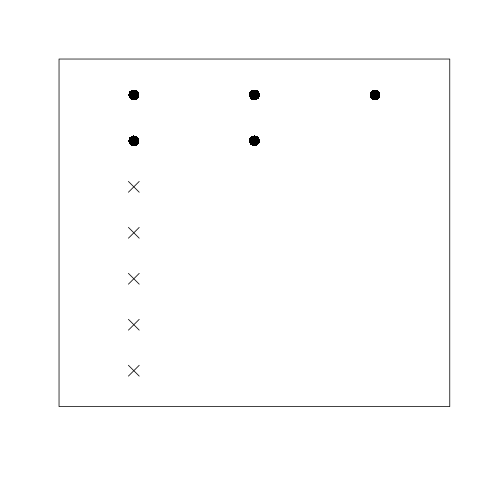
If I should get tenured in 2028, I will retire in 2052 (about 26 years of work ahead of me). This means, I will supervise about 7 generations of PhD students. I'm currently at the second generation.
in general
Here is what I know about academia.
No, it's not The Incentives—it's you. But —
Academia is a pyramid scheme. Most people stay on fixed-term contracts for decades before dropping out. A few lucky ones get permanent positions and stay in academia. These people often have survivorship bias. They will convince others to pursue a career in academia.
The publish-or-perish culture puts pressure on everyone, especially on early career researchers. While discontent with the current situation seems to be growing, change is happening slowly. Under these circumstances, it is important for us not to de-base or de-humanise ourselves through self-exploitation.
I also quite like this statement from Matthias Beyer on research.
my research interests
A doctorate with me should address one of these broad research topics.
collapse ecohydrology
How do ecohydrological systems collapse?
hillslope ecohydrology
How do plant traits and ecohydrological interactions self-organise hillslopes?
urban–environmental interfaces
How do interfaces regulate coupled fluxes between urban green systems and their surroundings?
the journey
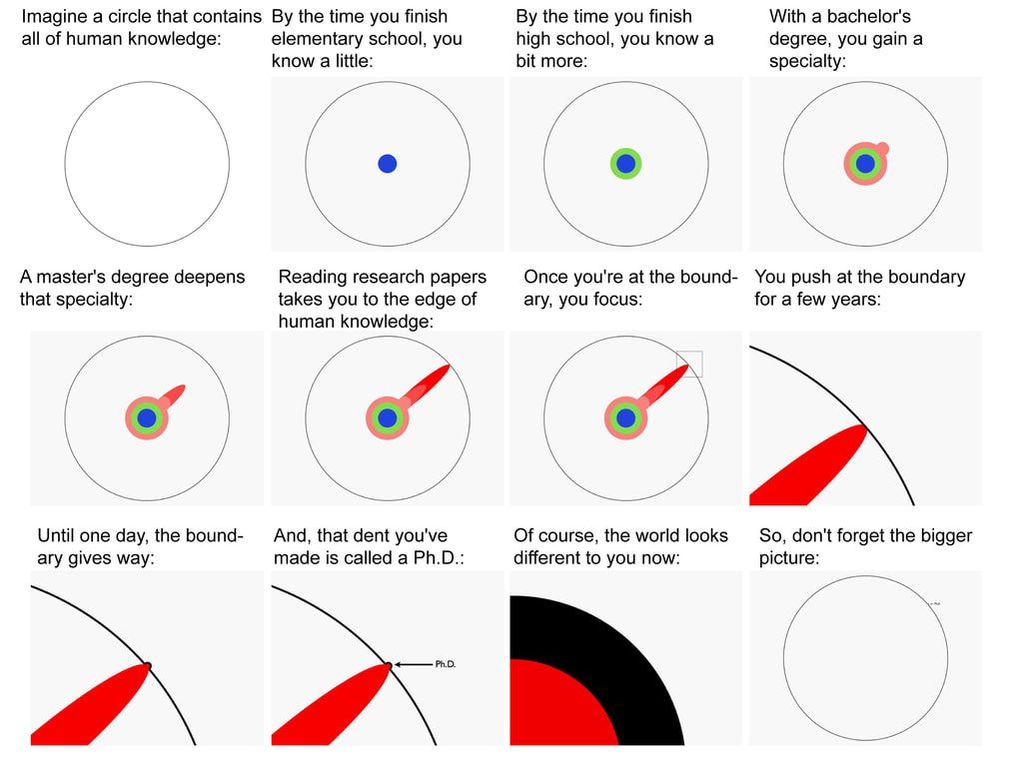
Source: Matt Might
Here is what I know about doing a PhD.
In Germany in MINT disciplines, there are two main ways to get an opportunity for doing a PhD: (i) getting hired for a research project and (ii) getting hired as a teaching assistant. There are other ways, for example, bringing your own funding through a scholarship or a company. We don't call it PhD, we call it Doktor. We also specify the discipline that the Doktor is in.
For example, in my group, we are allowed to give the degree Doktor der Naturwissenschaften (Dr. rer. nat.) for natural sciences and Doktor der Ingenieurwissenschaften (Dr.-Ing.) for engineering sciences.
truth
In Germany, university education is strongly associated with learning independence. Students are expected to self-organise their study programme. In most MINT programmes, only a few courses mandate showing up to classes.
The PhD extends on this philosophy. A PhD degree attests that its holder can carry out independent research. The work during your master thesis is research under supervision, where the topic is supervised but not how you organise your time. The PhD starts as a supervised topic but is supposed to end with you carrying out research independently.
In my personal experience, at the beginning of your PhD journey, you may have high expectations on me as your supervisor. In our first year, I may have deeper knowledge on some aspects of your topic.
As you advance in your research, usually in your second year, you may feel that my expertise is actually quite superficial or that I have knowledge gaps. You may feel disappointed in me. You will start to challenge my suggestions and we will have good discussions. This is actually good, because it shows that you are becoming an independent researcher. At the end of your PhD, your expertise in your topic will have surpassed mine and you will see that during our meetings the dynamic may have changed: I will accept most of your suggestions. This change in our relationship is the end goal of the PhD. It is what we are looking for. You should be able to demonstrate expertise in your own niche topic and independence from your supervisor.
giving a talk
Here is what I know about giving a talk.
Most of our talks fall into the category of informative speech. We want to convey information. Some of our talks may be persuasion speeches, where we try to convince others to act in a certain way. However, at conferences and workshops, the talk will be the first one.
A typical structure of an informative speech is as shown in the table below (Kirberger, 2012).
| i. Introduction (15–20%) |
|
| ii. Main part (70%) |
|
| iii. Conclusion (10–15%) |
|
NDF: numbers, data, facts; CEFE: comparisons, experience, figures, examples
The main recommendation for preparing a technical presentation is to start with identifying three key messages that we want to convey. A key message is a single sentence, it's not a header of a slide. We then add NDF and CEFE to the key messsages. At the very end, we add the introduction and conclusion.
preparation
In a bit more detail:
- Clarify the circumstances of the presentation
- Analyse the target audience
- Answer the ‚so what‘ question (why the audience should care about your presentation)
- Define the goal of your talk
- Collect information and ideas
- Formulate key messages and put them in logical order
- Provide NDF and CEFE
- Formulate the introduction and the conclusion
- Practice
comprehensibility
This is the most important aspect of our talk. The main goal is to make the talk comprehensible to the auience. We need them to be able to follow us as much as possible.
The following allegedly makes it easier for the audience to understand our talk:
- Simplicity — distilled presentation, short sentences, explaining technical terms
- Outline — structured, easy to follow the thread
- Brevity — reduced to the essentials
- Stimulation — interesting, lively, variety
writing a paper
Here is what I know about writing a paper. Not much.
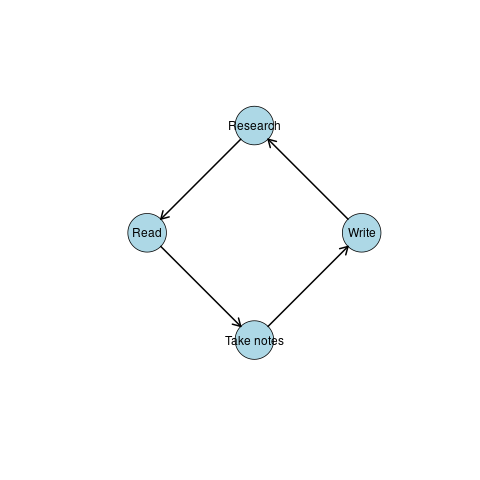
A general rule of thumb is that we need to read more than we write.
simplicity
A research paper needs to have one single clear research question that is simple to understand. The whole paper needs to address this research question. This is very important. The quality of the research question is directly related to how stimulating the paper is.
coherence
Once a term is introduced, we need to stick to it. This is very important. We also must be aware that definitions of terms vary across disciplines. It is important that we use the correct terms for what we want to convey within the context of our discipline.
brevity
A research paper is a distillation of hard work. Most of this hard work will not be mentioned in the paper. In fact, we need to say as little as possible. The less we say, the better. Because the more we say, the more likely it is that we make mistakes.
outline
This advice for outlining a paper is good.
See also this post by Göktuğ Kayaalp if you are writing by hand.
literature management
Here are my notes about managing my library.
collector's fallacy
The collector's fallacy states that only collecting articles without reading them gives us a false sense of accomplishment. A discussion of this fallacy can be found in Umberto Eco's How to write a thesis, but I guess the phrase was coined by Christian Tietze.
the knowledge cycle
bibliography bankruptcy
We can apply the concept from the emacs init file bankruptcy to our bibliography to refer to an overloaded bibliography database that becomes unmanagable.
tagging
- Use as few tags as possible
- Limit yourself to a self-defined set of tags
- Tags in this set must not overlap
- Tags are in plural
- Tags are lower case
- Tags are single words
- Keep tags on a general level
- Omit tags that are obvious
- Use one tag language
- Explain your tags
Rules #4 and #6 are not feasible for me, so I ignore them. The other ones are very useful.
my tags
- domain/ecohydrology
- domain/plant-hydraulics
- domain/soil-physics
- domain/urban-hydrology
- context/trait-based-ecohydrology
- context/dynamic-non-equilibrium
- context/hillslope-organisation
- pr/hillslope-ecohydrology
- pr/urban-green-interfaces
- pr/collapse-ecohydrology
- method/inverse-modelling
implementing in ebib
In ebib (see emacs), it is possible to define a canonical keywords list. First, we write down all keywords in a file (one keyword per line). Then, we can point to it:
(use-package ebib
  :config
  (setq ebib-keywords "/path/to/keywords.txt")
  ;; force ebib to use only these keywords
  (setq ebib-keywords-add-new-to-canonical nil)
  (setq ebib-keywords-field-keep-sorted t))
But I want to use the same keywords in both ebib and my org files. The hacky solution is to define keywords:
(setq il/canonical-keywords
      (with-temp-buffer
      (insert-file-contents "/path/to/keywords.txt")
      (split-string (buffer-string) "\n" t)))
Then re-write the ebib config:
(use-package ebib
  :config
  (setq ebib-keywords il/canonical-keywords)
  ;; force ebib to use only these keywords
  (setq ebib-keywords-add-new-to-canonical nil)
  (setq ebib-keywords-field-keep-sorted t))
implementing in org mode
In the org mode configuration, we define keywords consistently with ebib as:
(use-package org
  :config
  (setq org-tag-alist
        (mapcar (lambda (kw)
                  (cons kw nil))
                il/canonical-keywords)))